
How Google Ads new feature AI Max will impact your performance
Your campaigns are already working, why bother with AI Max?

Hey, it’s Jess 👋. Welcome to the Audience First weekly newsletter, helping B2B companies lead with their audience rather than the platform.
You’ll learn how to improve your marketing by starting with your ICP rather than the platform.
If you’re looking to introduce an audience focused approach to your marketing strategy, book an appointment today.
Read time: 2.5 minutes
In the past, I used to wait to make updates to my ad campaigns.
I remember when Google got rid of the broad match modifier keyword match type.
This new match type was going to be replaced by broad match.
They were recommending changing your match type to broad match.
Honestly speaking, I was afraid of letting go of control.
What if it didn’t work and I wasted ad spend that I couldn’t explain?
I ignored Google’s recommendation to transition and guess what happened?!
Google forced the changes. My keywords transitioned into broad match without my say.
I noticed this update after the performance dropped.
Can you blame me for avoiding this update?
I wanted to make sure that I didn’t break anything by making updates.
If it’s not broken, don’t fix it right?
The old me would run with this motto, but updates now are different.
The broad match modifier update only impacted one match type.
The upcoming change is bigger with broader keyword updates and the retirement of a campaign type.
As we start to see more AI features being adopted, we’re seeing fewer manual options.
And if you don’t keep up Google will force the change on you.
Thankfully, you have some time to make this transition yourself.
The new change doesn’t come into play until September 2026.
After that, no more DSA campaigns; it will be completely retired.
Any DSA campaigns that are still active will automatically be migrated to an AI Max campaign.
AI Max is a new feature that uses audience signals to help you reach users beyond your keyword offering.
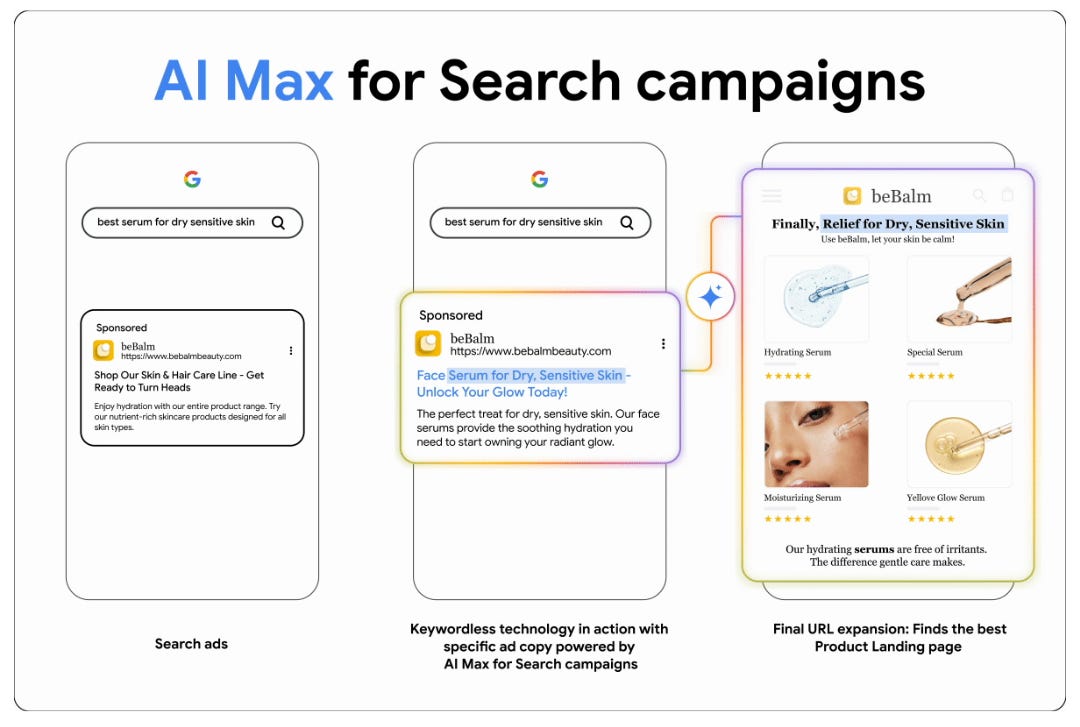
It optimises for conversions and not qualification.
Choosing to tighten the targeting is no longer the fix.
Because it doesn’t fix the issue around the conversion type being fed into the algorithm.
Which means that your campaigns will continue to optimise towards low quality leads regardless of you tightening the targeting.
Instead, you should focus on the signals that you are feeding the platform.
Below are 3 inputs to think about:
ICP clarity - As we see a shift away from keywords, having a clearly built out audience will make it easy to differentiate between a good/bad lead. Everyone in the team will be clear on the ideal customer and how to filter the CRM before lead data is fed to the algorithm.
Conversion signals - feeding the platform lead data will better inform it what a high quality lead looks like for your business. The algorithm will use the data to optimise the campaigns to find high quality conversions.
Audience first creatives - serving your ICP with the right creatives is a feature that you still have some control over. It speaks to your ICP’s pain points, which will help your ad stand out to them. If you missed my last post on creating ad copy for your ICP → check it out here.
All this information is great, but it gets even better when you action it.
Start by auditing your current activity.
What conversions are you currently optimising towards?
Is your CRM data being fed back into Google?
Now that you’ve got a starting point, I would take action.
Learn from my earlier experience and adopt change early.
This will allow for testing or slowly phasing in Google’s new shiny feature.
If you found this post useful, share it!
Connect with Jess
Is this your first time here? Subscribe (it’s free)
Follow me on LinkedIn for more insights
Strategise with me: Introduce an audience focused approach to your marketing efforts → book an appointment today

Recommend Jess Baaphy’s Newsletter to your Readers
An audience first marketing newsletter, helping B2B companies lead with their audience rather than the marketing platform.